The halls of higher education in Florida, traditionally seen as environments of opportunity and growth, are currently the front lines of a high-stakes legislative battle. As we move through the second quarter of the year, a new and aggressive proposal haemerged in Tallahassee that seeks to block individuals "unlawfully present" in the U.S. from attending Florida’s public colleges and universities. While the headlines often focus on the term "undocumented," the legal reality is far more complex, casting a long shadow over Florida’s 2026 student visa landscape. At the Sekou Clarke Law Group, we understand that for many of our clients in Orlando, Panama City Beach, New York, and Kingston, Jamaica, the path to a degree is intertwined with a complex web of pending applications and temporary statuses. When the state moves to "block" access, it isn't just targeting those without papers—it is creating a chilling effect for anyone whose status is currently "in process."
The Proposal: A Financial and Educational Wall
The core of this latest proposal is a direct assault on the educational aspirations of Florida’s immigrant youth. By seeking to prohibit state colleges from enrolling anyone deemed to be in the country unlawfully, Florida is attempting to override the long-standing precedent that education is a primary driver of economic integration.
For years, students who grew up in Florida—regardless of their initial entry status—could access in-state tuition and pursue degrees that allowed them to contribute to the state's economy. The new proposal seeks to dismantle this, creating a "documentation barrier" at the registrar’s office. This isn't just about who can sit in a classroom; it is about who is allowed to have a future in the Florida workforce. As we have seen with the failed attempts to restrict Workers’ Comp and banking earlier this session, the state’s strategy is one of "attrition through friction." If you can’t work, can’t drive, and now, can’t learn, the state hopes you will simply leave.
The Impact on Potential Student Visas (F-1, J-1, M-1)
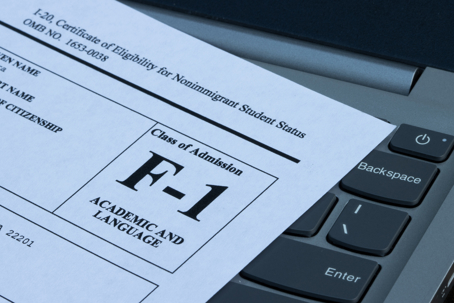
One of the most significant concerns for our firm is how these state-level crackdowns affect those currently navigating the federal student visa process. For a student abroad applying for an F-1 visa, or a student in the U.S. seeking a "Change of Status" (COS), the state’s hostile environment creates a unique set of hurdles:
1. The "Authorized Stay" Conflict: Under federal law, an individual might be in a "Period of Authorized Stay" while an application is pending. However, Florida’s 2026 proposals often use a much narrower, state-defined version of "lawful presence." This discrepancy can lead to a student being federally authorized to remain in the country but state-blocked from enrolling in classes.
2. Institutional Over-Correction: Admissions offices are not immigration courts. When faced with aggressive state penalties for "improperly" enrolling a student, many colleges will naturally "over-correct." We are already seeing reports of students with valid, pending visa applications being denied admission or being told they must pay out-of-state rates because the school "cannot verify" their status to the state’s satisfaction.
3. The Loss of Post-Graduation Pathways: A student visa is often a stepping stone to an H-1B or a Green Card. By blocking access to the degree itself, Florida is effectively shutting off the "talent pipeline" that brings high-skilled workers into the state’s tech and medical sectors.
The Financial Wall: Beyond the Classroom
Even for those who manage to enroll, the "financial wall" is becoming insurmountable. The loss of access to in-state tuition is a devastating blow. In Florida, the difference between in-state and out-of-state tuition can be as much as $15,000 to $20,000 per year. For a family working in Florida’s service or agricultural industries, that is the difference between a child becoming a doctor or remaining in a cycle of low-wage labor.
Furthermore, these proposals often go hand-in-hand with restrictions on financial aid and scholarships. We are seeing a trend where state-funded grants (like Bright Futures) are being tied to the same "proof of citizenship" standards recently implemented for voting under the SAVE Act.
The "Chilling Effect" on Dreamers and DACA Recipients
While DACA (Deferred Action for Childhood Arrivals) remains a federal program, Florida's 2026 legislative tone has made many "Dreamers" feel like they are being pushed back into the shadows. For certain students, the constant threat of policy changes has real-world consequences: delayed graduations, the loss of in-state tuition, and the psychological toll of being told they don't belong in the only home they’ve ever known.
Consequently, many students are choosing to leave Florida entirely, taking their talents to states like New York or California, where the educational environment is more inclusive. For the Sekou Clarke Law Group, this shift is a tragedy for the State of Florida, but it marks a reality we must help our clients navigate.
How the Sekou Clarke Law Group Can Help
In Florida’s 2026 student visa landscape, you cannot afford to be passive. Whether you are an international student seeking to study in Orlando or a Florida resident fighting for your right to in-state tuition, our firm offers the authoritative defense you need.
Status Clarification Letters: We provide colleges and universities with formal legal memos explaining a student’s federal "Authorized Period of Stay," ensuring that admissions officers don't misinterpret state mandates.
Change of Status (COS) Expediting: If you are in the U.S. and need to transition to a student visa (F-1) to remain compliant with new state laws, we handle the federal filing with the precision needed to avoid "documentation gaps."
Litigating Tuition Disputes: If you have been unfairly classified as "out-of-state" despite living and working in Florida, we challenge the university’s determination based on existing state and federal statutes.
Naturalization for Students: For those eligible, we accelerate the path to citizenship, providing the ultimate shield against state-level educational restrictions.
If you or your child is facing a "hold" on your registration or a sudden spike in tuition costs due to status questions, you must act immediately. The state is counting on you to be intimidated; we are here to ensure you are empowered.
The Sekou Clarke Law Group believes that education is a right, not a privilege reserved for those with the "perfect" paperwork. Don't let Tallahassee’s latest legislative block stop your future.
Call us today at (407) 269-8774 to schedule an appointment. We serve clients in Orlando, Panama City Beach, New York, and Kingston, Jamaica. Whether you are navigating the high-tech surveillance of Polk County or the admissions office at a major university, we are your fortress in a changing world.